.jpg?width=1200&name=AI%20in%20enterprises%20(1).jpg "AI in enterprises (1)")
June 25, 2026
THE DEMAND CRISIS
THE DEMAND SHOCK
The four largest US hyperscalers entered 2026 with combined annual capex approaching $600 billion. Worldwide data center capex is projected to reach $1.7 trillion by 2030, roughly 2.5 times the $700 billion 2025 baseline (Dell'Oro Group, February 2026; Omdia, December 2025). Data center load alone is expected to add 65–90 GW of new US demand by 2030, with total demand reaching 106 GW by 2035 (Grid Strategies, 2025; BloombergNEF, December 2025).
The grid cannot keep up. The US is expected to add roughly 170 GW of new generating capacity between 2025 and 2030, falling short of the 90–170 GW of peak load growth projected over the same period (Rabobank, June 2026; EIA). New gas capacity (55–65 GW expected 2025–2030) is not closing the gap. The supply crunch is most acute through 2028–2029.
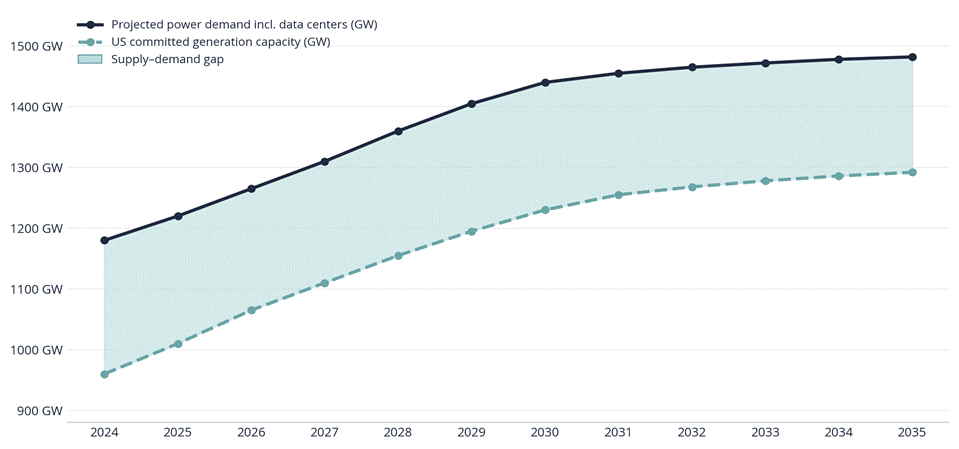
Sources: S&P Global 451 Research (demand forecast, 2026); Grid Strategies National Load Growth Report (2025); EIA capacity projections; BloombergNEF data center load forecast (December 2025). Demand includes data center, industrial, transport electrification, and baseline load. Supply includes committed additions and planned retirements.
THE SHIFT TO DISTRIBUTED POWER
The structural shift underway is from a centralized, utility-dependent power model to a distributed one. It’s a lengthy and difficult process to site and build utility-scale power generation in the U.S. Lead times for natural gas turbines routinely push to three years, and a shortage of other critical power infrastructure (transformers, medium-voltage switchgear) is contributing to the slow development of traditional power generation projects. The constrained supply environment is driving up costs for all power developers, creating political headaches, and widening the gap between forecasted demand and forecasted supply.
Hyperscalers are not waiting. They are contracting for behind-the-meter and onsite generation at scale. Gas turbines are filling near-term gaps, with BCE Consulting's analysis indicating that data center on-site gas generation is growing at a 24% CAGR through 2030. Battery energy storage systems are scaling in parallel, with the US BESS market expected to reach $5.7 billion by 2030. But neither gas nor storage alone solves the reliability, carbon, and long-duration baseload problem that hyperscale AI workloads demand.
SMALL MODULAR REACTORS: THE DATA CENTER CASE
WHY SMRS FIT DATACENTERS
Small modular reactors are factory-built fission reactors producing up to 300 MW. They are not a new idea; naval designs date to the 1950s. What changed is the demand environment. For decades SMRs stalled because conventional reactors were assumed to enjoy economies of scale that smaller designs could not match. Rising AI demand, interconnection backlogs, and carbon commitments flipped that calculus. Datacenter operators no longer need the cheapest megawatt-hour on an unconstrained grid; they need firm, carbon-free, behind-the-meter power on an accelerated timeline, and they are willing to pay for it.
The fit is structural, which is why the datacenter niche is durable:
• Queue bypass. Behind-the-meter siting sidesteps grid interconnection queues that now run three to five years in constrained markets.
• Firm baseload. 24/7 carbon-free output that no renewable can match at scale without long-duration storage, which remains expensive and unproven at gigawatt scale.
• Scalable deployment. Modular construction adds capacity incrementally, avoiding the all-or-nothing capital commitment of a gigawatt-scale plant.
• Price tolerance. Datacenter OEMs open their wallets to remove anything that stands between them and faster time-to-market.
Momentum is real. Google, Amazon, Meta, and AWS have all signed SMR power purchase agreements. Announced sector investment exceeded $30 billion between 2020 and 2025. NuScale earned the first SMR NRC design certification in 2023, with its uprated 77 MWe module approved in May 2025, and Ontario Power Generation broke ground on a BWRX-300 at Darlington in 2025 — the first grid-scale SMR under construction in the Western world.
But the extent to which SMRs will be adopted across future data center sites remains to be seen. These commitments are small relative to other areas of spend, and wherever hyperscalers have viable, less expensive options they are likely to pursue them.
WHY THE OPPORTUNITY STOPS THERE (ALMOST)
The features that make SMRs attractive to datacenters make them unattractive almost everywhere else onsite power is needed. SMRs do not fundamentally improve the cost position of nuclear power for utility-scale generation. Serial factory fabrication should bring costs down over time, but SMR power will not be cost-competitive with gas, solar-plus-storage, or wind for buyers who lack a datacenter's specific constraints and price tolerance.
Exceptions may include government, and in particular defense, applications where baseload reliability and remote site viability command a similar premium. Regardless, the opportunity remains niche.
|
|
SMR |
Gas / Diesel |
Solar + Storage |
Wind |
Geothermal |
|
Baseload reliability |
|
|
|
|
|
|
Carbon emissions |
|
|
|
|
|
|
Deployment speed |
|
|
|
|
|
|
Upfront capital |
|
|
|
|
|
|
Fuel cost risk |
|
|
|
|
|
|
Process heat |
|
|
|
|
|
|
Remote site viability |
|
|
|
|
|
|
Regulatory burden |
|
|
|
|
|
|
|
Favorable |
|
Moderate / Conditional |
|
Unfavorable |
Power infrastructure OEMs are right to pay attention to SMRs, which are likely to be a sustainable and highly profitable niche opportunity over the next several decades. But how focus and investment should also reflect the relative size of the prize, which is likely to pale in comparison with the broader market.
BCE’S RELEVANT EXPERIENCE
BCE has been tracking the intersection of power demand, energy infrastructure, and capital deployment for several years. The following cases reflect where our work is directly relevant to the energy and data center infrastructure market. For industrial companies across the power value chain, the positioning window is now — before first-wave SMR revenues materialize. Companies making qualification investments and developer relationships between 2025 and 2028 will capture disproportionate supply chain value through the 2030s.
ELECTRICAL DISTRIBUTION EQUIPMENT MARKET SIZING — IPO SUPPORT
BCE sized the U.S. electrical distribution equipment market at $33.1 billion in 2025, growing at a projected CAGR of approximately 20% through 2030. The analysis was built on primary research with EPCs, OEMs, and utility buyers across data centers, grid, industrial, BESS, and solar segments. BCE's work was incorporated into the offering materials for Forgent Power Solutions' $1.5 billion initial public offering on the NYSE. The analysis identified data center as the fastest-growing segment at a 29% CAGR, driven by AI-fueled hyperscale buildout and a coming wave of retrofit demand beginning in 2027-2028.
Market Sizing, Capital Markets, Data Center Infrastructure
DATA CENTER ELECTRICAL INSTALLATION PRODUCTS — MARKET ENTRY STRATEGY
BCE was engaged by a global industrial technology company to assess the data center electrical installation products market, evaluate competitive dynamics, and identify inorganic growth opportunities. BCE conducted primary research across hyperscale owners, EPCs, electrical contractors, and OEMs, and developed a market forecast projecting 19% CAGR growth through 2028. The engagement covered product segmentation, value chain analysis, purchasing criteria by customer type, and a competitive landscape assessment, identifying share positions and go-to-market strategies of key players. Deliverables included strategic options for market entry and identified M&A targets.
Market Assessment, Competitive Intelligence, M&A Strategy
DEFENSE ENERGY STORAGE — OPPORTUNITY ASSESSMENT AND PARTNER IDENTIFICATION
BCE conducted an 80+ stakeholder primary research program to assess the energy storage opportunity for a defense electronics manufacturer across naval and ground platform applications. The engagement covered customer requirements mapping, competitive dynamics, battery technology evaluation across 19 manufacturers, and a dynamic partner prioritization framework. BCE provided actionable prioritization of battery partners by application type and identified adjacent growth pathways including international and cross-platform opportunities. The energy storage themes from this work — high-pulse power, SWaP constraints, domestic supply chain requirements — are directly relevant to the onsite generation and BESS dynamics now shaping commercial data center infrastructure decisions.
Energy Storage, Primary Research, Defense Markets
SELL-SIDE ENERGY DILIGENCE – DATA ASSESSMENT AND PLATFORM
BCE was retained to develop an IPO-ready market diligence view of a data center infrastructure platform’s addressable market across modular solutions, power components, and cooling infrastructure. BCE built a dynamic TAM/SAM forecasting model using bottom-up capacity and spend-per-unit assumptions, complemented by demand-driver analysis, buying criteria assessment, competitive share mapping, and an adjacency attractiveness framework. BCE delivered a market model and diligence report with public-filing-ready assumptions that quantified the opportunity by segment, identified which markets best aligned with the company’s differentiation, and flagged where architectural shifts, lead-time constraints, and customer concentration could affect growth. This type of capital markets diligence — pairing rigorous market modeling with primary research across the value chain — is directly applicable to the next wave of power infrastructure and SMR-adjacent companies preparing for transactions.
Energy Storage, Primary Research, Defense Markets