.jpg?width=1200&name=AI%20in%20enterprises%20(1).jpg "AI in enterprises (1)")
October 6, 2026
BCE Consulting's AUSA 2026 Series
This is the second piece designed to help you get the most from AUSA 2026. The series examines how Continuous Transformation is changing budgets, delivering capability to soldiers, and creating new questions, risks, and opportunities.
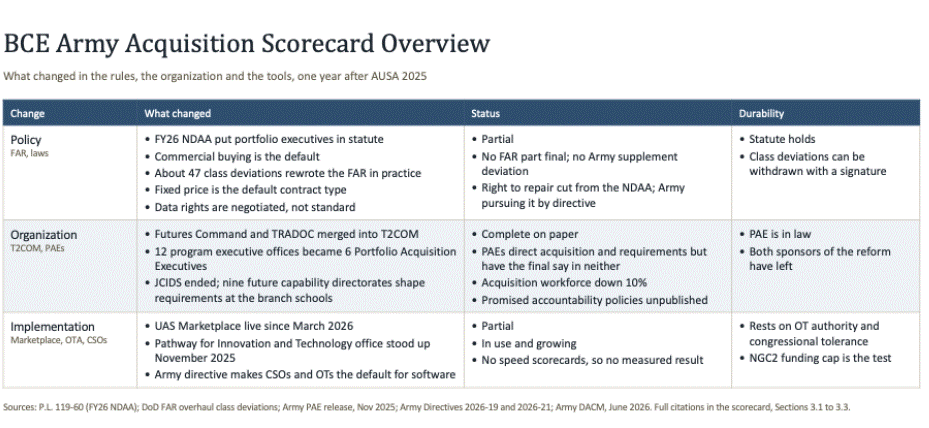
At AUSA 2025, Army leaders promised generational acquisition reform as a key enabler of Continuous Transformation. BCE evaluated the reform after year 1 – see the Scorecard Overview below – and found new doors to opportunity but a lot of work in progress behind those doors. For example, the entire streamlined acquisition rulebook runs on legal permissions, but they are temporary; not a single part of the Federal Acquisition Regulation has completed rulemaking.
The Army wanted to buy more efficiently, secure stronger rights, and field faster. How the resulting opportunities reach you depends on whether you are an incumbent or a nontraditional challenger and the risks associated with what you sell.
Current State: Two-speed acquisition, set by risk, not institutional inertia
The acquisition system now provides three doors running at two speeds. Two are fast. The Pathway for Innovation and Technology office delivers results in months, and the unit demand path, exemplified by the UAS Marketplace, delivers in weeks. Traditional program offices are still working in years.
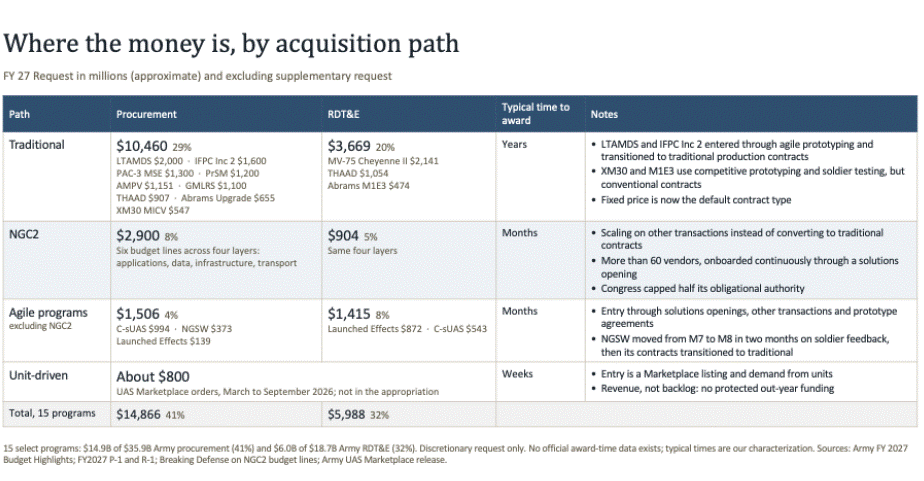
The Army is moving fast where a mistake is inexpensive and recoverable. Units bought roughly $800M of drones through the UAS Marketplace in six months. The squad weapon shifted from the M7 to the XM8 in two months on soldier feedback.
Where an error costs years and lives, the path is still traditional: rotary-wing aircraft, tanks, interceptors, artillery, ammunition.
The fast lane still merges into a program of record. LTAMDS, IFPC Inc 2, and the squad weapon entered through agile pathways and have since moved to conventional contracts.
However, the agile doors are an entrance. They are not a business model yet. NGC2 is the test of whether agile scales to high risk: sixty-plus vendors, $2.9B in procurement, growing without converting.
Behind the doors: real, partially complete, and reversible
Fiscally, there is progress, but agile money is modest, about 12 percent of both procurement and RDT&E. NGC2 has most of it. Science and technology fell 27 percent, narrowing a path common to new entrants. Congress wrote the commercial-first path into law and it is most powerful in areas where risk is low.
The paths to influence requirements and acquisition have changed. Portfolio Acquisition Executives are now established in law and direct acquisition and requirements, but have the final say in neither. Branch schools, rather than centralized processes or cross-functional teams, now own most requirements.
Expect inconsistency between contracting offices into 2027. Acquisition reform has a legal footing but is in flux. The current model rests on 47 class deviations and the government has not finalized any FAR, DFARS, or AFARS revisions. Data rights are negotiated now and firms need to price them into their value proposition. Congress has stopped the right to repair for now; the Army pushes it by directive instead.
Quick Wins for Incumbents and Challengers
Low-risk kit:
- Incumbents: entrants who lost their S&T on-ramp present a lucrative opportunity
- Challengers: you know how to win work. Build production capacity and compliance now; conversion is coming
- Incumbents: while the debates on data and right to repair continue, audit your risks and rights now; understand their value.
- Challengers: find a way to apply agile practice here and you own the category
High-risk platforms:
Everyone: M1E3 and MV-75 Cheyenne II are the next tests of whether agile reaches high-risk programs.
The full scorecard tracks the AUSA 2025 Acquisition Reform plan, what has been implemented, what has changed, and what it means for firms in the defense space. BCE’s team will be at AUSA to discuss the full scorecard.